Solution MultiCloud / Hybrid Cloud
Free yourself from managing software such as Kubernetes, Terraform, and Ansible.
Focus on the essentials of your project with our solution.

Why resilience is important when it comes to your public cloud (or web hosting) provider
A company's resilience with regard to its public cloud provider is crucial to ensuring business continuity and data security. Here are four key reasons why a company should be resilient when it comes to its public cloud provider or hosting provider.
1- Availability and continuity of operations
Public cloud providers offer services distributed across multiple data centers around the world. However, even large companies can experience outages or incidents. A resilience strategy enables a company to minimize the impact of these interruptions by implementing failover and disaster recovery solutions. This ensures that critical business operations can continue with as little disruption as possible, thereby ensuring service availability.
2- Data security
Data security is a major concern for businesses, especially when storing sensitive information in the cloud. A resilient approach involves implementing robust security measures, such as identity and access management, encryption of data in transit and at rest, and constant threat monitoring. In the event of a security incident, a resilient company is better prepared to detect, contain, and recover quickly, minimizing risks and losses related to data security.
3- Flexibility and operational agility
Business needs are changing rapidly, and the ability to adapt quickly to change is essential.
Resilient cloud architecture enables a company to be agile and flexible by adopting practices such as automating operations, automatically scaling resources based on demand, and implementing distributed architectures.
This ensures that the company can respond quickly to new opportunities or challenges, while optimizing costs and ensuring efficient use of cloud resources.
4- Flexibility in the choice of suppliers
When a company adopts a resilient approach to its public cloud provider, it also gives itself the ability to switch providers if necessary. Contractual changes, pricing changes, or other external events can influence the relationship with the cloud provider.
By being resilient, a company can anticipate these changes and develop strategies to migrate to other suppliers seamlessly, thereby maintaining operational continuity and avoiding excessive dependence on any one supplier.
This flexibility also ensures that the company can take advantage of technological innovations and competitive opportunities offered by other cloud service providers.
In summary, resilience with respect to public cloud providers is essential to ensuring continuous availability, data security, and operational flexibility for a business in an ever-changing IT environment.
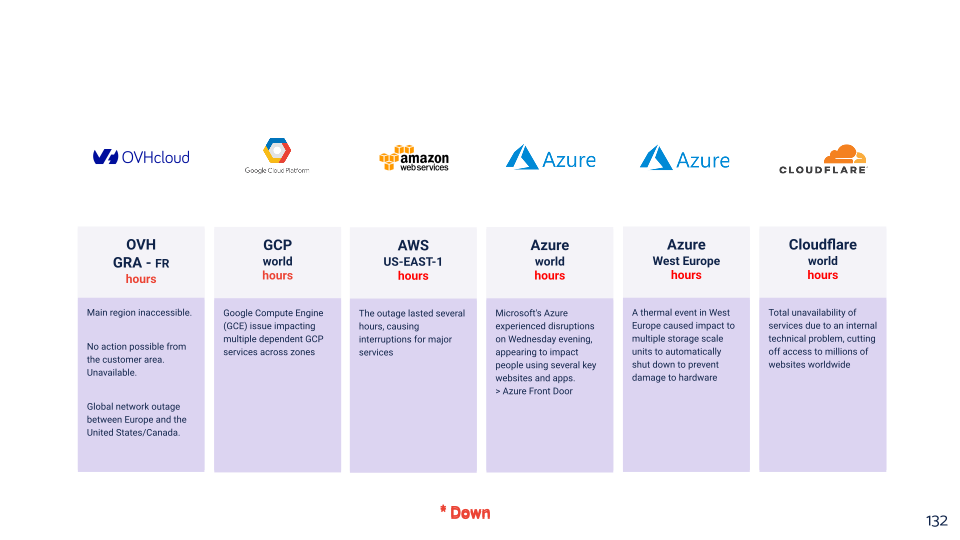
Multicloud strategy to strengthen resilience
Adopting a multicloud strategy, i.e., using multiple cloud service providers, is a proactive approach to strengthening a company's resilience in the face of the challenges mentioned above. This strategy offers several advantages:
Risk diversification
By using multiple cloud providers, a company distributes its workloads and data across different infrastructures. This means that in the event of an incident or outage at one provider, operations can switch to another provider without significant interruption, minimizing risk and improving availability.
Cost optimization
Competition between cloud providers can lead to pricing variations. A multicloud strategy allows a company to choose the services best suited to its specific needs while optimizing costs. In addition, it offers the possibility of migrating to providers offering more competitive rates without being locked into a single platform.
Contractual flexibility
When faced with contractual changes, a multicloud strategy gives the company the flexibility it needs to adjust its relationships with suppliers according to its needs. It can also respond quickly to market developments, technological opportunities, and regulatory changes without being limited by a single contractual relationship.
Continuous innovation
Different cloud providers may offer unique features and services. A multicloud strategy allows a company to take advantage of continuous innovation by adopting the latest technologies offered by different market players, while avoiding dependence on the capabilities of a single provider.
By integrating a multicloud strategy, a company strengthens its resilience by creating a more flexible, adaptable architecture capable of coping with a wide range of scenarios, including outages, pricing changes, contractual events, and other external issues.
Data sovereignty and legal protection
A multicloud strategy also offers a company the ability to select cloud service providers operating in specific jurisdictions, thereby addressing concerns related to data sovereignty and protection from extraterritorial laws.
Data sovereignty
Some countries have strict regulations regarding data storage and processing, particularly personal data. By adopting a multicloud strategy, a company can choose providers that operate in jurisdictions that comply with data sovereignty requirements, thereby ensuring compliance with local regulations.
Legal protection
Extraterritorial laws, such as the Cloud Act in the United States, can raise concerns about privacy and data protection. By choosing cloud providers in different jurisdictions, a company can reduce the risks associated with such laws by ensuring that data is stored and processed in areas where legislation offers adequate protection.
Regulatory compliance
By taking into account the specific regulations in each jurisdiction, a company can better manage regulatory compliance. It can choose suppliers that guarantee compliance with local laws and adopt practices that protect data in accordance with applicable requirements.
By integrating data sovereignty into a multicloud strategy, a company can strengthen its position in the face of challenges related to personal data protection, confidentiality, and regulatory compliance, while maintaining the flexibility needed to adapt to legal and technological changes.