
How LayerOps responds to the challenges of the Data Act.
Here is a clear, up-to-date, and practical summary of the obligations under the Data Act (EU Regulation 2023/2854) concerning :
- cloud service portability (cloud switching),
- interoperability,
- multi-cloud resilience.
⚡ This text will be gradually implemented starting in 2025. Cloud obligations are central to European providers and multi-cloud platforms such as LayerOps.
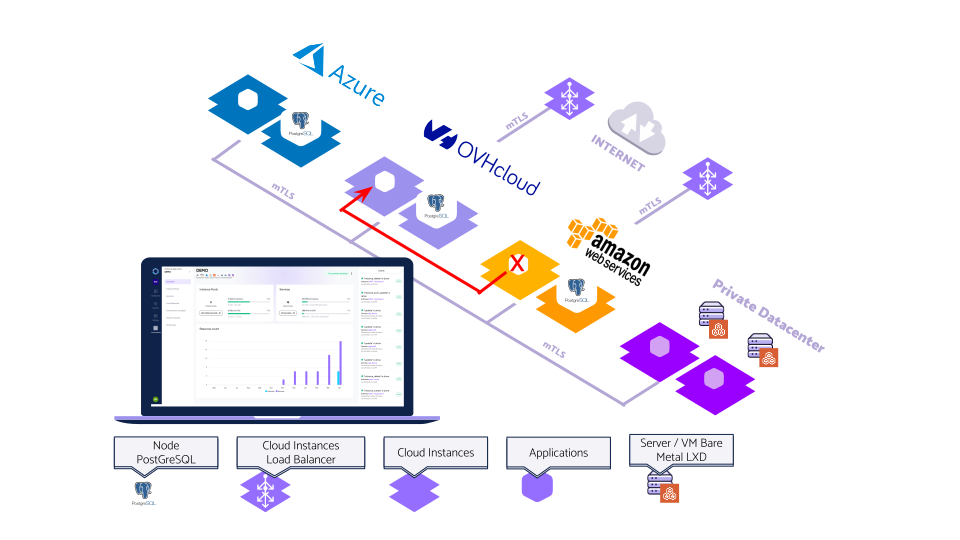

1. Objective of the Data Act on the cloud: break lock-in and facilitate multi-cloud
The Data Act imposes mandatory rules on cloud service providers (IaaS, PaaS, SaaS) to enable:
- full data portability,
- the reversibility of applications,
- the transition to another provider without friction,
- the ability to use multiple clouds (multi-cloud) or on-premise environments,
- operational resilience, avoiding dependence on a single supplier.
This is a major regulatory revolution for European architectures.
2. Key obligations regarding the portability of cloud services
End of vendor lock-in
Cloud providers must make it possible to switch providers without technical, contractual, or financial obstacles.
This includes:
Data portability
-
The customer must be able to export all of their data, including:
- usage data,
- metadata
- configurations,
- logs,
- images, snapshots, volumes,
- configuration files (YAML, Terraform, Docker Compose, etc.).
Application and workload portability
-
Suppliers must facilitate the compatibility of execution environments:
- containers
- VM,
- database,
- API.
Open formats
Data must be exportable in structured, widely used, machine-readable formats.
Documentation enabling the switch
The supplier must provide:
- API documentation,
- diagrams
- complete migration procedures,
- guaranteed deadlines.
Predictability and legal certainty
The contract must clearly state:
- the migration procedures,
- any costs,
- portability deadlines,
- technical limitations.
3. Obligations regarding migration costs
Elimination of exit fees
Suppliers may no longer charge fees for:
- data copying,
- portability,
- migration to a competitor.
Only costs actually incurred (e.g., outgoing bandwidth) may be passed on, and for a transitional period until January 2027 at the latest.
After 2027 → exit fees = $0.
4. Interoperability obligations
Interoperability is becoming a regulatory requirement, particularly for PaaS services.
The supplier must guarantee:
- documented and standardized APIs
- automated export/import mechanisms
- market-compatible interfaces
- the possibility of using third-party tools
Suppliers must adopt European or international standards, or justify why they do not use them.
5. Multi-cloud resilience requirements
This point is key: the Data Act encourages companies to stop relying on a single supplier.
Obligation to allow the simultaneous use of multiple clouds
Suppliers must ensure that their services can be combined with:
- other clouds,
- sovereign clouds,
- private clouds,
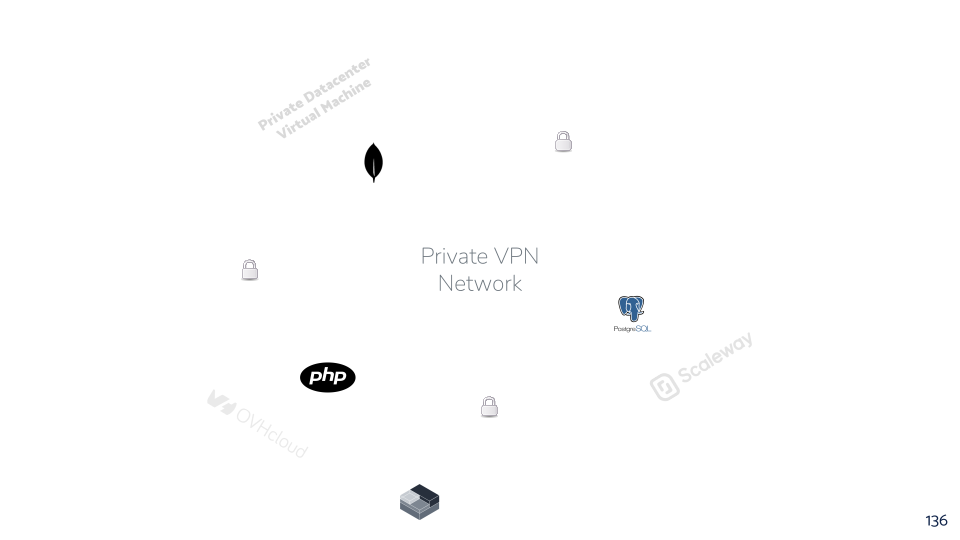
- on-site data centers.
No contractual restrictions
A supplier may not prohibit:
- data replication to another cloud,
- the use of competing services,
- the use of multi-cloud tools.
Ability to distribute a service across multiple environments
The customer must be able to:
- perform part of its service with another provider,
- synchronize or replicate data,
- ensure continuity in the event of a major failure (resilience).
That is precisely the aim of the Data Act: to promote multi-cloud for European resilience.
6. Security, availability, and business continuity
Suppliers must guarantee:
- high availability,
- exportable backup and replication mechanisms,
- incident recovery, even from a third-party cloud,
- documentation that can be used in a crisis situation.
Conclusion
The Data Act greatly strengthens LayerOps' value proposition:
➤ Portability: LayerOps orchestrates containers independently of the provider — direct compliance.
➤ Interoperability: use of containers, S3 storage, etc.
➤ Resilience: multi-cloud/hybrid cloud-native architecture.
➤ Cost reduction: no more exit fees → multi-cloud = more accessible.
➤ Sovereignty: customers can migrate to a sovereign cloud or a private data center.
👉 LayerOps is a turnkey Data Act compliance platform.
We are convinced that LayerOps is the ideal solution to meet your cloud computing needs, including those related to the concept of sovereign cloud.
Contact usfor a demonstration and discover how LayerOps can transform your approach to the cloud.
Read also: Why be resilient with your public cloud provider?

Interface unifiée
Déployez vos instances n'importe où
depuis une interface unique et
profitez des mêmes fonctionnalités,
quel que soit votre fournisseur de
services cloud.
Réservez une démo
LayerOps n'applique aucune marge sur les instances que vous déployez. Tout est déployé sur vos comptes,
vous gardez le contrôle total et restez administrateur de votre fournisseur.